
AI generators in business: practical use, limitations, and the role of engineering
Summary
This research takes a practical look at AI generators in business, focusing on where they help teams move faster, where they break, and what it takes to integrate them reliably into existing products. It shows why engineering decisions matter more than model choice when AI generators are used beyond experiments.

Dmitry Grishanovich
Head of .NET Department
AI generators are increasingly used by businesses as a practical optimization tool. Not as an experiment, and not as a replacement for teams, but as a way to speed up specific types of work.
In most cases, companies are not trying to “adopt AI.” They are looking for ways to reduce the time spent on routine intellectual tasks: preparing drafts, generating internal summaries, responding to standard customer requests, or working with structured data. These activities are necessary, but they do not always require manual effort at every step.
AI generators can automate parts of this workload and help teams move faster without expanding headcount. When applied to the right tasks, they improve operational efficiency and free resources for higher-value work.
The business value depends on how AI generators are applied within existing processes and systems. Their effectiveness relies on clear use cases, controlled inputs, and proper integration into the company’s IT environment. The key question is whether they can be used in a predictable, controlled, and scalable way.
What AI generators actually do
From a technical perspective, these tools generate output based on the instructions and data you provide. They follow a recipe given to them, operating within predefined rules rather than using independent reasoning.
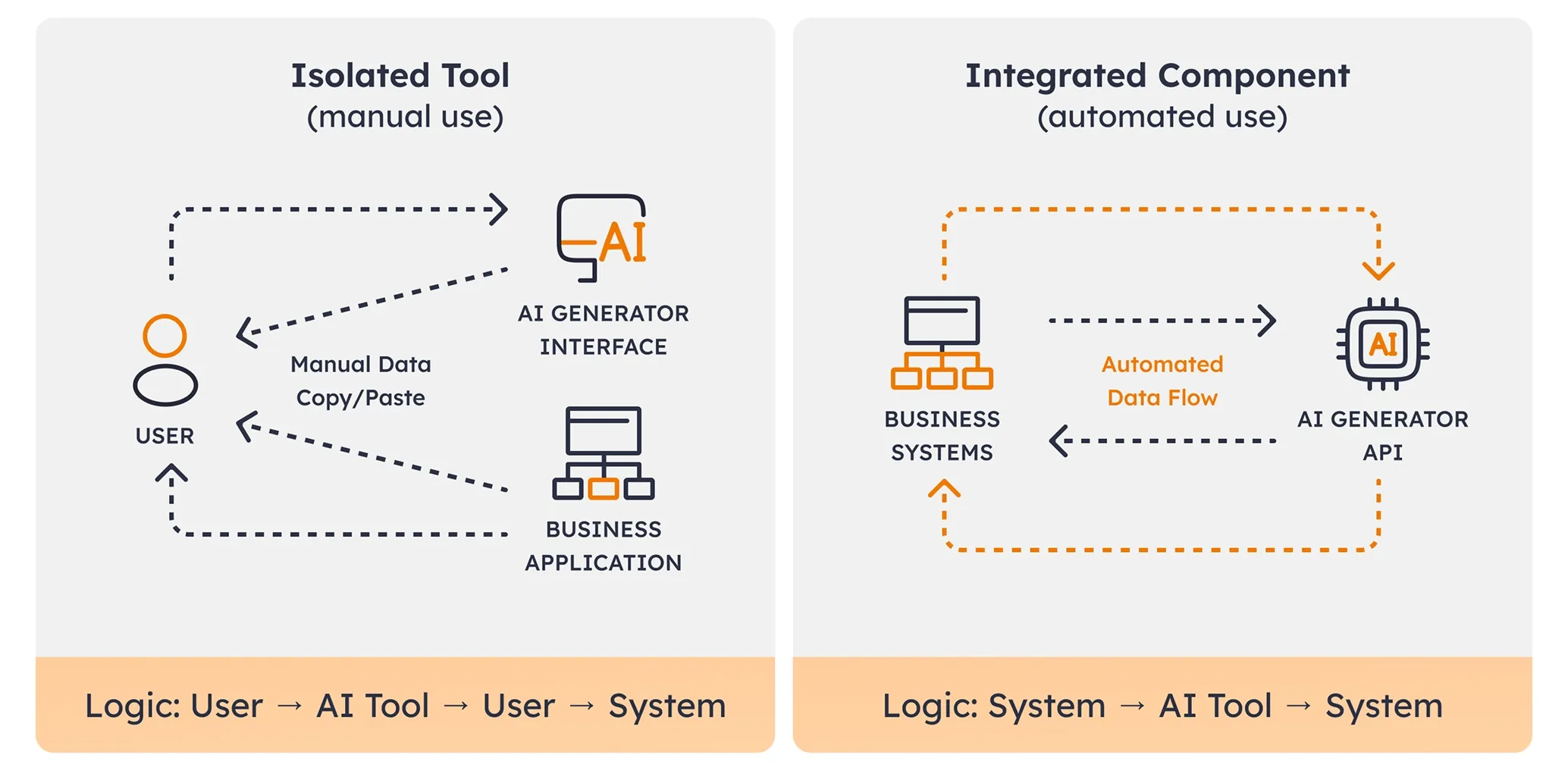
A comparison of manual vs. integrated approaches for AI generators implementation
Think of an AI generator not as a finished product, but as a specialized component you connect to your existing software. Instead of being a standalone app, it’s a service that your main business systems (like your CRM or e-commerce platform) can call upon to perform a specific task and get a result back.
This distinction is important. AI generators do not “understand” business goals on their own. They operate strictly within the logic defined by your existing software and business rules. Without clear inputs, boundaries, and validation rules, the output becomes inconsistent and difficult to control.
That is why AI generators should be treated as part of the application architecture. Their behavior, limitations, and failure scenarios must be considered in the same way as any other external service you integrate into your business. When you connect a payment system like Stripe or a mapping tool like Google Maps, you design how they fit into your processes. The same approach is needed for AI.
As a result, working with AI generators focuses on how the tool will fit into your daily operations and who is responsible for its output, not just on which AI model is the most powerful.
Where AI generators bring real business value
The strongest results appear in processes that are repeatable, well-defined, and context driven.
These are tasks where the structure is clear, the variability is limited, and the output can be reviewed or validated before use.
Content and marketing tasks
AI generators can assist with drafting texts, adapting content for different channels, or preparing first versions of product descriptions and internal documentation. In these scenarios, they reduce preparation time while leaving final control with the team.Analytics and reporting
In analytics-related workflows, AI generators can help interpret structured data, generate summaries of reports, or prepare explanations for non-technical stakeholders. For example, an AI generator can take a huge, complex sales report covering dozens of product types over a six-month period and instantly turn it into a short, structured summary with key analytics, sales forecasts, and actionable insights for management.Customer support and internal use
AI generators can help prepare responses to standard requests, summarize conversations, or support internal teams with access to structured knowledge. For instance, when a support employee opens a customer ticket, the system can automatically use the AI to draft a response by analyzing the query and pulling information from the knowledge base. The employee's task then becomes to quickly review and personalize the draft before sending it, significantly reducing ticket resolution time.Across all these cases, the pattern is the same. AI generators are valuable when they work as an assistant, automating routine steps in a workflow. They help your team perform tasks, but the final decision and ultimate responsibility always remain with people.
Why AI generators break without proper integration
Most failures occur when AI generators are introduced as isolated tools instead of being embedded into existing systems.
AI generators are often perceived as tools that can be plugged in and used immediately. From an IT perspective, they behave like any other system component: their value depends on architecture, integration, and control.
When this perspective is missing, AI generators remain disconnected from core systems. They do not have reliable access to structured data, their output is difficult to validate, and their behavior varies across use cases. As a result, the same tool produces inconsistent results in similar scenarios.
Consider a company that uses a standalone AI chatbot for customer support without integrating it into its CRM system. A customer asks about their order status. Since the chatbot isn't connected to the order database, it can only provide a generic answer like, "Please contact our support team for order information." This creates a frustrating experience and adds no value. If the chatbot were properly integrated, it could have retrieved the order status directly from the CRM and provided an instant, accurate answer.
Addressing these limitations requires deliberate system design and implementation. AI generators must be embedded into the application architecture, with clearly defined data access, output handling, and error management. This work is typically carried out by development teams responsible for the product and its architecture. They determine how AI generators interact with existing systems, which constraints apply, and how AI-driven functionality is monitored and maintained over time.
From Modsen's experience across 14+ years of market expertise and over 250+ delivered projects, successful AI implementations are rarely about model choice. They are about designing the surrounding system so that AI-driven functionality behaves predictably, remains maintainable, and scales with the product.
How to approach AI generators as part of a system
Reliable implementation starts with treating AI-generated output as part of an end-to-end workflow rather than an isolated result.
A structured approach to AI generators starts with system boundaries, not with prompts or tools. The first question is where AI-generated output enters the system and how it is used downstream.
Stage | How it works without a development team | How it works with a development team |
|---|---|---|
Defining Boundaries & Data Flow | Data is manually copied between systems. This process is slow, error-prone, and lacks real-time context. The AI operates in a vacuum. | The team designs automated data connections. They define which systems provide data to the AI, what context is passed, and where the output is used. This ensures the AI has reliable, up-to-date information. |
Embedding into Workflows | The AI tool remains a separate, optional step. Employees may or may not use it, and results are not integrated into official processes, creating operational silos. | Developers integrate the AI generator directly into the application's business logic. The AI-powered feature becomes a seamless part of the user's workflow, enhancing efficiency without disrupting the process. |
Control & Monitoring | Failures (e.g., unexpected output, cost spikes) are noticed manually, often after they have caused a problem. There are no automated checks, validation rules, or fallback plans. | The team implements system-level controls. This provides real-time data on performance and costs, giving you full control to influence the process at any moment and forecast future outcomes accurately. |
This kind of setup does not emerge on its own. It requires teams that understand your business, are familiar with your IT infrastructure, and respect your company's rules and standards. This is the difference between AI generators remaining experimental tools and becoming a reliable part of the IT system.
Final thoughts
Long-term value depends on whether AI-driven functionality is embedded into products with clear ownership and technical responsibility.
AI generators can deliver measurable value in business systems, but only when they are treated as part of the IT landscape rather than as standalone tools. Their effectiveness depends on architecture, integration, and long-term ownership, not on experimentation alone.
The real challenge is understanding how AI-driven functionality should be embedded into existing products and processes to remain predictable, maintainable, and scalable.
Without the support of an experienced development team, even the most powerful AI generator can become a useless tool, applied incorrectly and disconnected from the business processes it's meant to improve. This is why having a reliable technology partner is critical for success.
If you are considering using AI generators in your product or internal systems, we invite you to a free technical consultation. We can help you assess the feasibility, evaluate the risks, and design a clear integration plan before implementation begins.
Core references
1.
Kleppmann, M. (2017). Designing Data-Intensive Applications. O’Reilly Media.
2.
Richards, M., & Ford, N. (2020). Fundamentals of Software Architecture: An Engineering Approach. O’Reilly Media.
3.
Huyen, C. (2022). Designing Machine Learning Systems. O’Reilly Media.
4.
Sculley, D. et al. (2015). Hidden Technical Debt in Machine Learning Systems. Advances in Neural Information Processing Systems (NeurIPS).
5.
Amershi, S. et al. (2019). Software Engineering for Machine Learning: A Case Study. International Conference on Software Engineering (ICSE).

Get a weekly dose of first-hand tech insights delivered directly to your inbox